Which software should you use to play music remotely? 2026 Comparison

One band member now lives in another city, the rehearsal room is unavailable this week, or the only time slot that works for everyone would mean spending almost as long on the road as rehearsing. You may simply want to keep working on a song between studio sessions.
In each of these situations, the problem isn't finding musicians: the band already exists and wants to keep playing. What becomes complicated is getting everyone in the same room regularly.
You could postpone the rehearsal, practise separately, or exchange recordings: these solutions have their uses, but they don't replace the moment when musicians play and react together. Remote rehearsal software is designed to preserve that shared way of playing when meeting in person isn't possible.
The promise sounds simple, but delivering on it is much harder: a conversation tolerates a slight delay fairly well, because everyone waits their turn without really thinking about it. In music, that same delay can be enough to make it difficult to stay in time. The result then depends on the software, but also on the distance, the path your data takes across the Internet, the stability of each connection, the computer and the audio interface.
Not all solutions address exactly the same need either. Some prioritise technical control, others simplify setup as much as possible. Some are mainly for rehearsing with a band that already exists; others also let you join public sessions or meet new musicians.
To make these differences concrete, we picked four software options often cited for playing together remotely: Jamulus, SonoBus, JamKazam and NuCorder. This selection isn't exhaustive: FarPlay, JackTrip, Jamodio — currently in private beta —, Bonza Music and other projects also exist.
This comparison is published by NuCorder, so claiming absolute neutrality wouldn't be credible. What we can do instead is make our criteria explicit, rely on each vendor's public information, and acknowledge the cases where another solution better fits the need.
Quick overview
| NuCorder | Jamulus | SonoBus | JamKazam | |
|---|---|---|---|---|
| Price |
| Free and open source | Free and open source |
|
| Audio architecture | Centralised servers | Client-server | Peer-to-peer | Peer-to-peer or server, depending on connection and plan |
| French interface | ✅ Yes (also English) | ✅ Yes | Not at the time of our review | ❌ No |
| Video | Built in | ❌ No | External service offered via VDO.Ninja | Depending on plan, from Silver |
| Recording | Local, no time limit, on Free and Premium | If enabled by the server | ✅ Yes | From Gold |
| Audio quality | 3 levels (Low/Normal/High), Opus-based, tuned for low latency | Configurable (Opus-based codec) | Configurable: uncompressed PCM or Opus | 128 to 512 kbps, depending on plan |
| Systems | Windows / macOS; Linux on a best-effort basis | Windows / macOS / Linux | Windows / macOS / Linux / iOS / Android (beta) | Windows / macOS |
Pricing and features were checked in September 2026. They may change: each vendor's official page remains the reference.
Jamulus: free, open-source and proven
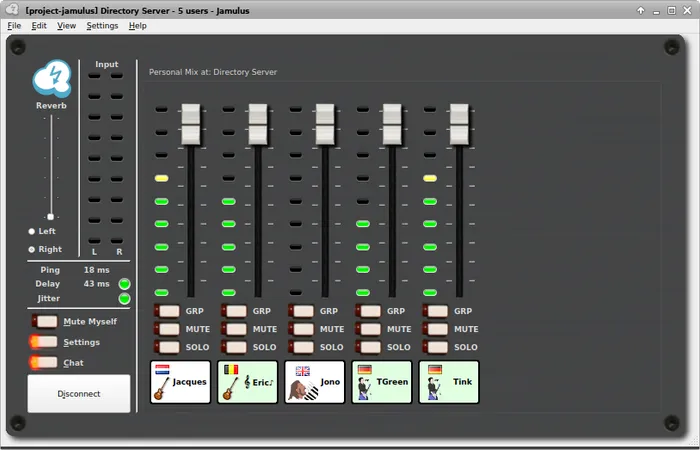
Jamulus is one of the pioneering projects in remote music-making. The software is free, open source, and has been maintained by an active community for many years.
It runs on a client-server architecture: each musician joins a public or private server, which receives the audio streams before redistributing them to the other participants. Many public servers are available, and it's also possible to host your own.
This freedom comes with a trade-off. The interface is functional rather than welcoming, and the first setup requires understanding a few audio and networking concepts. Recording depends on the server used, and there's no built-in video.
Jamulus is therefore a solid choice for musicians who are comfortable with technical setup, bands looking for an entirely free solution, or people who want to join public servers.
SonoBus: fine-grained control over peer-to-peer audio
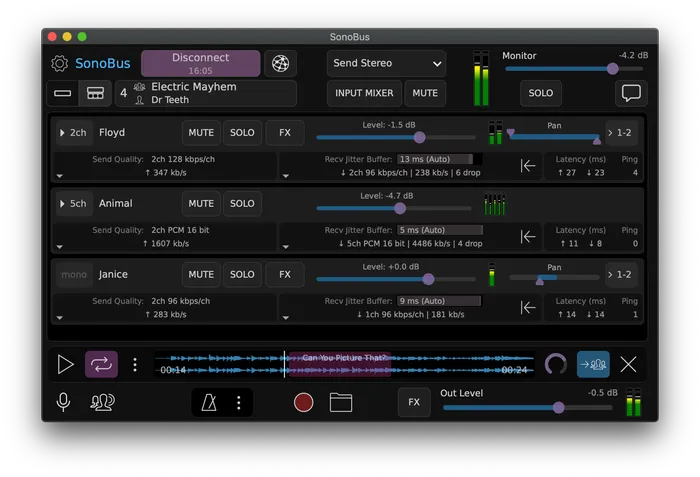
SonoBus takes a different direction. Audio streams flow directly between participants; the connection server mainly helps them find each other. The software is free, open source, and available on both desktop and mobile.
Its main strength lies in the control it gives users over the sound. Each user can adjust quality, compression, buffers and the mix they receive. SonoBus can work with uncompressed PCM or use the Opus codec, with different settings per participant.
This flexibility comes at the cost of more parameters to manage. In a peer-to-peer architecture, every connection between two participants matters directly. As the group or the distances grow, bandwidth and stability become harder to control, and the setup becomes harder to understand and manage.
SonoBus is particularly well suited to musicians who want to keep control over audio processing, especially for small-group sessions.
JamKazam: a platform and an international community

JamKazam isn't just an audio app. The platform offers public sessions, social features, video, recording, and tools for meeting other musicians.
Its architecture can use peer-to-peer connections or route through JamKazam's server network to find the most favourable path. Access to that network, audio quality, video and recording all depend on the plan chosen.
The free plan limits each session to one hour, total usage to four hours per month, and the number of participants to four. Silver raises total usage to 10 hours per month; only Gold and Platinum remove that limit entirely. Recording starts with Gold; video is available from Silver, and audio quality itself scales with the plan, from 128 to 512 kbps. New accounts also get a 30-day free trial at the Gold level.
This structure makes the platform comprehensive, but also harder to sum up in one line: two users may not have access to the same capabilities within the same session. The interface and support also remain mostly in English.
JamKazam is aimed mainly at musicians who want to join international sessions, meet new partners, or have access to a broader ecosystem around remote playing.
NuCorder: rehearse with the musicians you already know
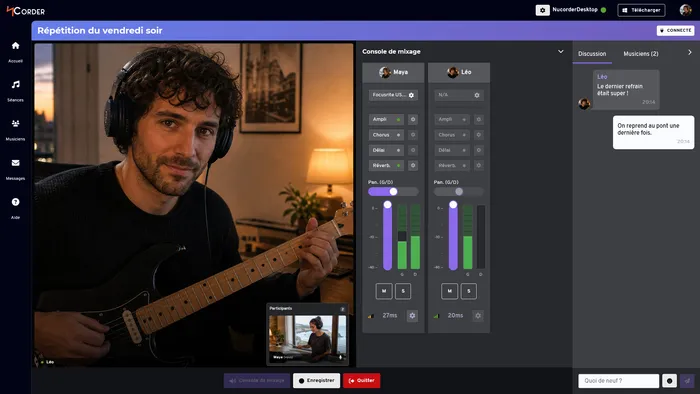
NuCorder focuses on a narrower need: you already know who you want to play with, but distance, travel, or an unavailable rehearsal room get in the way.
Rather than accumulating features, NuCorder aims to shorten the path from sending an invitation to actually playing together: preparing each setup, joining a private session, restoring your settings and checking that audio works in both directions.
Technically, audio streams pass through NuCorder's servers rather than connecting each participant directly to every other. This choice simplifies setup for some group configurations and allows processing to be centralised, but it doesn't remove network constraints. The distance to the server hosting the session, Internet routing, the computer, and the audio settings still shape the result.
NuCorder is regularly tested on Windows and macOS. A Linux version remains available, but it's offered on a best-effort basis: we don't currently have a recent Linux machine to validate every release under the same conditions and guarantee the same level of quality. Linux users are therefore encouraged to check their setup with their bandmates before planning a full rehearsal.
NuCorder remains a young product. Its community is smaller than JamKazam's, its recommended coverage currently focuses on mainland France and several neighbouring countries, and users looking primarily to meet new musicians will find a more developed ecosystem elsewhere.
The free plan lets you create private sessions of 30 minutes, join or create open sessions with no time limit, and record locally with no time limit. Premium costs €12.90 (including tax) per month and includes:
- private sessions with no time limit;
- five amp simulations, a chorus and a delay;
- free guests can join private sessions hosted by a Premium subscriber without a time limit.
A 14-day Premium trial is available. A payment card is required to start the trial. The card is not charged immediately; the subscription can be cancelled before the trial ends.
Which solution should you consider for your needs?
A table can help point the way, but it will never replace a trial with your own gear and your own bandmates.
| Your priority | Options to consider |
|---|---|
| You want a free, open-source solution | Jamulus or SonoBus |
| You want fine control over audio quality and processing | SonoBus |
| You want to join public servers with a proven solution | Jamulus |
| You're looking for new musicians or international sessions | JamKazam |
| You rehearse with an existing partner or band and appreciate having a French interface option | NuCorder |
| You want to compare highly technical approaches | Jamulus, SonoBus or JackTrip |
| You just want to try the concept without commitment | Jamulus, SonoBus, FarPlay or NuCorder, depending on the type of session |
These recommendations aren't a ranking. Jamulus combines open infrastructure with a long track record, while SonoBus focuses on control. JamKazam offers a more developed international ecosystem; NuCorder concentrates on regular rehearsals with musicians who already know one another.
The right choice depends less on the number of features than on the problem you're actually trying to solve.
NuCorder's deliberate choices
Hosting the main infrastructure in France
NuCorder's main servers are currently hosted in France. This location allows reasonable coverage of mainland France, Belgium, Luxembourg and Andorra.
NuCorder remains accessible from other countries on a best-effort basis. The result then depends more heavily on distance and the path taken by the data. Learn more about NuCorder's geographic coverage.
Like most online services, NuCorder also uses third-party providers that may process some data on their own infrastructure.
Centralising audio streams
During a session, each participant connects to a NuCorder server. Their audio stream reaches that server before being sent on to the other musicians.
This choice avoids some of the constraints of peer-to-peer when several people play together. It doesn't, however, make quality independent of the network: an unstable connection, Wi-Fi, an overloaded machine, or a poorly configured audio interface can still degrade the session.
Aiming for low latency without promising a universal number
To play together, every millisecond counts. It would still be misleading to advertise a single latency figure valid for every setup: the measurement depends on the network, the distance, the computer, the audio interface and the settings chosen.
We'd rather show real sessions and let each band test their own setup than turn a measurement taken under good conditions into a general promise.
Supporting French-speaking musicians
NuCorder's app, documentation and support are available in both English and French. This choice doesn't change the sound quality, but it can make a real difference when you need to understand why a first session isn't starting as expected.
Letting you test before subscribing
The free plan lets you run a 30-minute private session with your band. That's enough time to check everyone's setup, test the connection, and work out whether NuCorder fits the participants' real-world conditions.
Premium becomes especially useful once the band wants to rehearse regularly and no longer be limited by the length of private sessions.
Frequently asked questions
What Internet connection do you need to play online?
A fibre connection is recommended, with each computer connected to its router by Ethernet. Wi-Fi can introduce latency and stability variations that are hard to compensate for when making music in real time.
Bandwidth alone doesn't predict the result, though: connection stability, Internet routing, and the distance between each musician and the server also matter.
What latency is acceptable for playing together?
There is no universal threshold. What feels acceptable depends on the instrument, tempo, distance and equipment. Drums and rhythmically active bass parts generally tolerate less delay than slower work on pads or sustained chords.
The most useful approach is to test with a song that reflects the way your band normally plays.
Do you need an external audio interface?
On Windows, the current version of NuCorder uses ASIO, so you need an ASIO-compatible interface or driver. On macOS, the audio mechanisms are different, but a properly configured interface is still recommended to reduce local latency and get a more predictable result.
On Linux, NuCorder remains available on a best-effort basis. Since we currently can't validate every release on a recent machine under the same conditions as Windows and macOS, compatibility and performance may vary by distribution and audio setup.
Can you play drums remotely?
It's possible, but drums are among the instruments most sensitive to delay. The result depends on the distance, the connection, and each musician's setup. It's best to test a session with your band before planning a full rehearsal.
Is NuCorder really free?
Yes. The free plan lets you create a 30-minute private session, invite your band, join or create open sessions with no time limit, and record locally with no time limit.
Premium is designed for bands who want to rehearse regularly in private sessions with no time limit.
Can you record a session?
Yes. NuCorder lets you record locally with no time limit, on both the Free and Premium plans. SonoBus also offers recording. On Jamulus, this depends on the server's configuration; on JamKazam, it starts with the Gold plan.
There is no universal winner
These four tools don't remove the complexity: they just move it. Jamulus takes more effort to learn but offers open infrastructure, while SonoBus provides extensive control at the cost of more configuration and the constraints of peer-to-peer networking. JamKazam brings many features together in an international platform whose capabilities depend on the chosen plan; NuCorder deliberately focuses on rehearsals with an existing band.
None of these approaches is inherently superior. The best solution isn't the one that ticks the most boxes in a table, but the one whose constraints match your band, your gear and how you rehearse.
With NuCorder, as with the other tools, testing under real conditions is more useful than relying on an abstract promise. Gather the people you want to play with, use your usual equipment and try a song that reflects the way your band normally plays: you will quickly know whether the solution fits your situation.